Faculty News
December 16, 2025
Faculty Joins Panel on Wealth Inequality
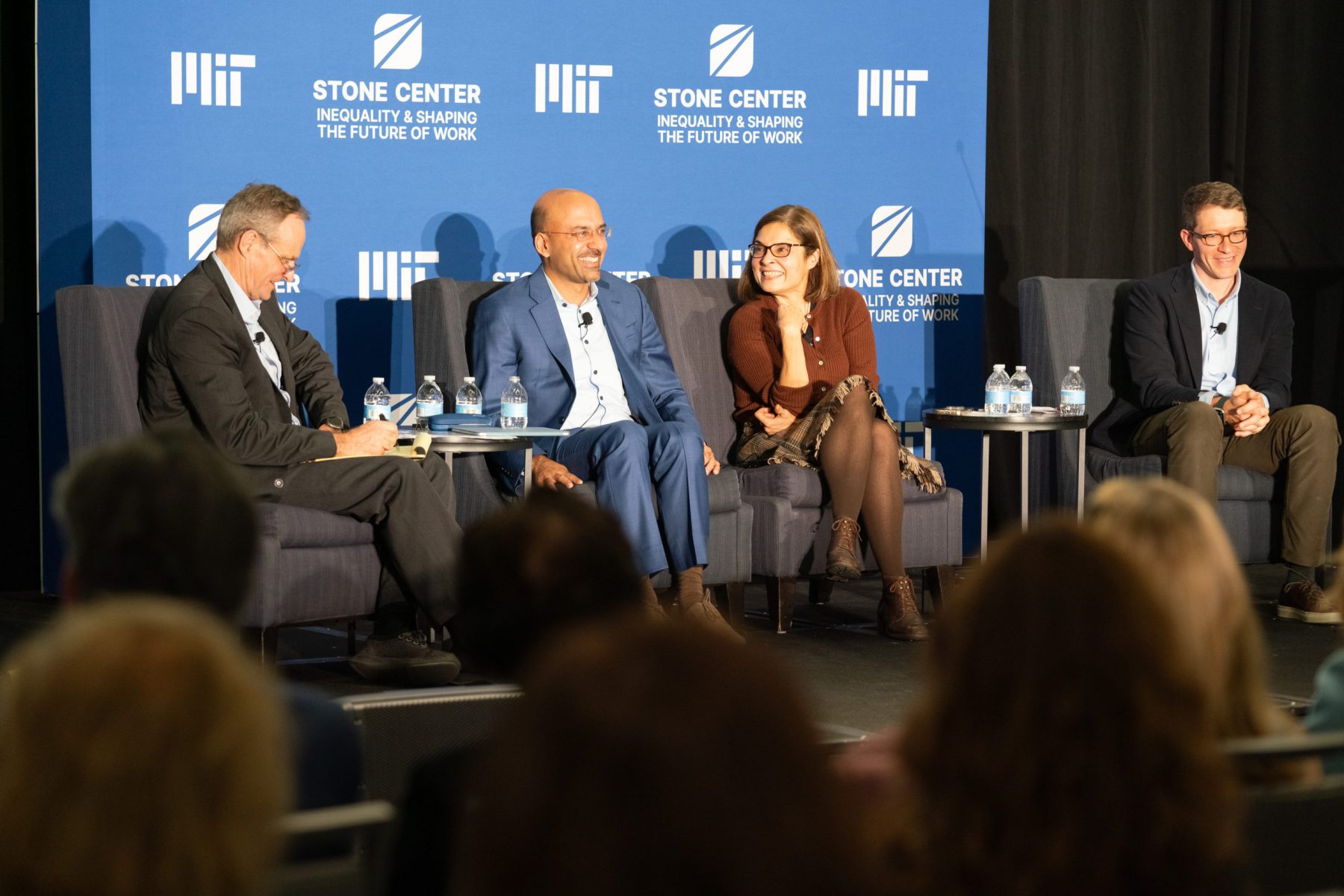
On November 3, the Stone Center celebrated its launch with an event that included discussions on wealth inequality, liberalism, and pro-worker AI. The Stone Center (James M. and Cathleen D. Stone Center on Inequality and Shaping the Future of Work) is a non-partisan research organization at MIT that applies economics research to identify innovative ways to move the labor market onto a more equitable trajectory.
The event’s first panel discussion included two professors from the Princeton Economics Department: Atif Mian, the John H. Laporte Jr. Class of 1967 Professor of Economics, Public Policy, and Finance, and Owen Zidar. Antoinette Schoar, the Stewart C. Myers-Horn Family Professor of Finance at the MIT Sloan School of Management, joined them on the panel, which was chaired by Simon Johnson, the Ronald A. Kurtz (1954) Professor of Entrepreneurship at the MIT Sloan School of Management.

Photo by Bryce Vickmark.
Discussing “Wealth Inequality: Causes and Consequences,” the panel began with a presentation by Zidar, who spoke on topics from his upcoming book, “The Everywhere Millionaire.” Zidar discussed his work with the Treasury Department to determine who is actually rich in America, beyond the top 1%, focusing on the rise of business owners. These “main street millionaires” collectively hold more wealth than the Forbes 400 list.

Photo by Bryce Vickmark.
Mian’s presentation followed Zidar and Schoar and centered on the “unequal roots of our debt crisis.” Looking at savings rates across the wealth distribution, Mian advises that while gross savings have grown, investment has not. He shows that this additional saving has been channeled into debt rather than investment.
“As inequality starts to rise in the 80s, you see a big divergence of people at the top 1% accumulating debt as an asset through the financial system, and they are lending that to the bottom 99%,” said Mian.
Watch the full panel discussion on YouTube.